International Technology Alliance (ITA), has won a ten-year, USD 135.8 million contract to provide research services for the US Army Research Laboratory and the UK Ministry of Defence.
ITA will provide research and development services to investigate advanced technology for secure wireless and sensor networks. The alliance will work towards enhancing the effectiveness of military establishments by contributing to their capabilities pertaining to the collection, interpretation, and distribution of battlefield information among themselves.
Monday, September 25, 2006
Monday, September 18, 2006
According to a study by Boston Consulting Group (BCG), Multinational Pharmaceutical Companies (MPCs) are increasingly exploring India and China as they are seeking various offshoring options for their R&D function.
The upcoming trend is attributed to the improving regulatory and competitive environment in the two countries. Amongst the findings, almost all the top 20 MPCs have outsourced their chemistry work to China.
The report states that the MPCs wishing to establish successful offshore R&D operations in India and China should adopt an integrated strategy, as against the ad-hoc strategies which are currently being followed by some of the companies operating in the domain.
The offshoring strategy should be flexible enough to incorporate the changes in the R&D capabilities of the two countries.
The upcoming trend is attributed to the improving regulatory and competitive environment in the two countries. Amongst the findings, almost all the top 20 MPCs have outsourced their chemistry work to China.
The report states that the MPCs wishing to establish successful offshore R&D operations in India and China should adopt an integrated strategy, as against the ad-hoc strategies which are currently being followed by some of the companies operating in the domain.
The offshoring strategy should be flexible enough to incorporate the changes in the R&D capabilities of the two countries.
Thursday, August 03, 2006
Genpact, a business services and technology solutions company will acquire Irvine-based MoneyLine Lending Services, a specialized provider of end-to-end mortgage origination and fulfillment services. Established in 1996, MoneyLine is a provider of outsourced mortgage services for more than 50 financial-institution clients. Terms of the deal, expected to close in August, were not disclosed.
Read the press release here
Thursday, July 06, 2006
Lessons Learned from Diamond Cluster Global Outsourcing Study:
In the qualitative portion of the research, DC asked Buyers and Providers to share their insights and experience with their peers. The following is a representative sample of their first-hand observations from the front lines of outsourcing.
Buyers
• Outsourcing is always harder than you originally thought.
• Cost savings alone is not a good reason to outsource.
• Leverage resources with experience and skills in outsourcing to help you develop your own sourcing strategies and execution roadmaps.
• Clearly define your goals, measurement metrics and exit strategies up front.
• Well-defined governance structures and proactive management and communication are the keys to success.
• Structure your vendor relationships as win/win propositions.
• Outsourcing your problems won’t solve them. You should fix potential problems first before you hand over the process to someone else.
• Establishing very specific and measurable SLAs is crucial for evaluating performance.
• Give providers a chance to be successful. Transitions take time.
• Due diligence on providers is essential if you want to avoid surprises.
• Internal resistance to outsourcing can be managed but you have to foster proactive and candid communications to succeed.
Providers
• Successful outsourcing requires strong buyer commitment.
• Be prepared to talk to buyers in terms of business value.
• Buyers and providers need to be long-term partners.
• Buyers should recognize that providers need time to be effective. Bringing on an outsourcer can’t happen over night.
• Buyer expectations and objectives are always evolving. Make sure you understand them at the outset and are nimble enough to satisfy them when they change.
• Resistance to outsourcing and uncertainty about its value are still issues in many organizations.
• Contracts and negotiations need to be customized for each situation.
• It’s still difficult for outsourcing firms to differentiate themselves and cost is still very important to buyers.
• You’ve got to be able to work closely and communicate clearly with buyer management to be successful.
• Cultural differences need to be acknowledged and managed.
• Establishing a mutual understanding about governance structures, SLAs and performance expectations is critical.
Profile of the Participants:
DiamondCluster’s Global Outsourcing Study includes the insights of 210 buyers and 242 providers of outsourcing services.
All of the participants are either directly involved or highly aware of their company’s outsourcing-related decisions.
The number of total employees in the participating companies ranged from 100 to more than 50,000. The number of IT employees on staff ranged from less than 100 to more than 50,000. IT budgets of participating companies ranged from less than $5 million to more than $500 million. Buyers participating in the survey conduct business in the financial services, professional services, insurance, consumer products, retail, telecommunications and public sectors.
The providers participating in the study range in size from less than 100 to more than 10,000 employees. Many of the outsourcing providers had operations in multiple locations, including Brazil, Canada, China, Egypt, France, Germany, Hungary, India, Malaysia, the Netherlands,Romania, Russia, Spain, Ukraine, the United Kingdom, the United States, and Vietnam.
Source: DiamondCluster Research
Wednesday, July 05, 2006
Now, It is CEOs' Attrition in India
Several top-level executives in the frontline offshoring companies have quit in the last one year drawing attention to the attrition in this segment. The good news, however, is that the movements are within the industry, in almost all cases, proving that it is just some readjustment and not a cause for concern...
Raman Roy who had started Spectramind in 1999, that soon became the No 1 BPO company in India and was sold off by Roy to Wipro.
Now Mr.Roy's planning his new venture QuatrroBPO.
Rizwan Koita and Jagdish Moorjani, who started Transworks, which was later acquired by Indian business group, AV Birla. The two have already started a company focusing on the healthcare space.
(Called ‘1shore’, the new company will offer end-to-end healthcare services and also provide financial services. They are currently in talks with a couple of US firms to provide end-to-end healthcare BPO. Read the story here)
Prashant Sahni quit as CEO Tecnovate-eBooker to start something fresh.
The Other CEOs/country heads who have quit in the last few months include...
Rakesh Chopra, as head of Amex offshore operations to EXL services
Romi Malhotra, as head of StanChart's offshore operations to Dell offshore Ops
RK Rangan, as head of Prudential offshore operations to Lehman's offshore
Convergys has lost two country heads in the past 12 months with Jaswinder Ghumman and Rakesh Chopra leaving, for some BPO heads movement has become par for the course.
Mr Chopra has travelled from Genpact to American Express, EXL, Convergys and back to Genpact.(Meanwhile Dr. Bawa Singh is the interim Vice President and Country Manager of Convergys India Press release)
Sunil Mehta, vice-president, Nasscom, told EconomicTimes India:
Need more?
Aparup Sengupta GTL-Mumbai
K R Viswanath - CEO Epicenter (Mumbai based Collections co.)
R Mohan - CEO of Hinduja TMTR Venkatesh Iyer - President, NIIT SmartServe
The following fellows have remained in this industry...
Sujit Baksi - President vCustomer India - joined Lehmen Brothers - quit- joined Tech Mahindra
Ravi Chandaran quit HP to head ANZ Grindlay’s back office
Kiran Shah - moved from Bank of America to join Goldman Sachs BPO
Ravi Bhatia quit World Bank BPO to join Genpact
Rakesh Kumar - President Global VantEdge ( joined IntelliRisk )
Anshuman Kankan - Head India Ops ePhinay (F&A BPO) (joined COLT Telecom India Offshore Center)
Shailaja Puranik - COO/Head India ops. Sitel ( Now COO Vertex India )
There are instances of top honchos in BPOs leaving to explore options in private equity. Sanjeev Agarwal leaving IBM Daksh for Helion Venture Partners and Akshay Bhargav leaving Progeon to join 3i are cases in point.
The good news, however, is that the movements are within the industry, in almost all cases, proving that it is just some readjustment and not a cause for concern.
I like the comment of Shyamanuja about this trend ...
Several top-level executives in the frontline offshoring companies have quit in the last one year drawing attention to the attrition in this segment. The good news, however, is that the movements are within the industry, in almost all cases, proving that it is just some readjustment and not a cause for concern...
Raman Roy who had started Spectramind in 1999, that soon became the No 1 BPO company in India and was sold off by Roy to Wipro.
Now Mr.Roy's planning his new venture QuatrroBPO.
Rizwan Koita and Jagdish Moorjani, who started Transworks, which was later acquired by Indian business group, AV Birla. The two have already started a company focusing on the healthcare space.
(Called ‘1shore’, the new company will offer end-to-end healthcare services and also provide financial services. They are currently in talks with a couple of US firms to provide end-to-end healthcare BPO. Read the story here)
Prashant Sahni quit as CEO Tecnovate-eBooker to start something fresh.
The Other CEOs/country heads who have quit in the last few months include...
Rakesh Chopra, as head of Amex offshore operations to EXL services
Romi Malhotra, as head of StanChart's offshore operations to Dell offshore Ops
RK Rangan, as head of Prudential offshore operations to Lehman's offshore
Convergys has lost two country heads in the past 12 months with Jaswinder Ghumman and Rakesh Chopra leaving, for some BPO heads movement has become par for the course.
Mr Chopra has travelled from Genpact to American Express, EXL, Convergys and back to Genpact.(Meanwhile Dr. Bawa Singh is the interim Vice President and Country Manager of Convergys India Press release)
Sunil Mehta, vice-president, Nasscom, told EconomicTimes India:
The industry is growing at 38-40% annually. Considering the growth, senior level
movement is not surprising.
Need more?
Aparup Sengupta GTL-Mumbai
K R Viswanath - CEO Epicenter (Mumbai based Collections co.)
R Mohan - CEO of Hinduja TMTR Venkatesh Iyer - President, NIIT SmartServe
The following fellows have remained in this industry...
Sujit Baksi - President vCustomer India - joined Lehmen Brothers - quit- joined Tech Mahindra
Ravi Chandaran quit HP to head ANZ Grindlay’s back office
Kiran Shah - moved from Bank of America to join Goldman Sachs BPO
Ravi Bhatia quit World Bank BPO to join Genpact
Rakesh Kumar - President Global VantEdge ( joined IntelliRisk )
Anshuman Kankan - Head India Ops ePhinay (F&A BPO) (joined COLT Telecom India Offshore Center)
Shailaja Puranik - COO/Head India ops. Sitel ( Now COO Vertex India )
There are instances of top honchos in BPOs leaving to explore options in private equity. Sanjeev Agarwal leaving IBM Daksh for Helion Venture Partners and Akshay Bhargav leaving Progeon to join 3i are cases in point.
The good news, however, is that the movements are within the industry, in almost all cases, proving that it is just some readjustment and not a cause for concern.
I like the comment of Shyamanuja about this trend ...
... we blame the 20-somethings for changing jobs because they prefer the canteen
of XYZ to that of ABC... They are at least are clear about why they are doing
it!
Source: Global Services, Convergys Corp, EconomicTimes, The Time Magazine, GoldmanSachs, McKinsey & Co Alumi, Managing Offshore

Friday, June 30, 2006
R&D Investment Heads East: Booz Allen Hamilton-INSEAD Study
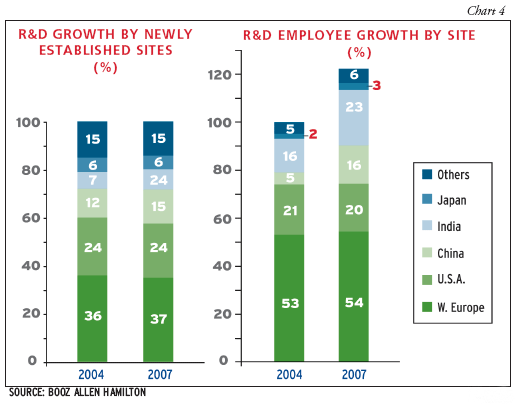

Picture/Research crtsy: Booz Allen Hamilton, Global Services
Sunday, June 18, 2006

The winners for the 2006 Everest Grp. Outsourcing Excellence Awards!
Best BPO - Hughes and ACS
Best ITO - Vanguard Car Rental and Perot Systems
Best EU - Invista and Freeborders
Best Financial Services - Channel Life and Alfinanz
Best Healthcare - St. Vincent Health System and Eclipsys
Best Business Challenge - Citrix and HP Global Services
Best Offshore - Delta Airlines and Wipro
Best Partnership - BT and Accenture HR Services
source: www.Outsourcing-center.com , Everest Group
Thursday, June 15, 2006
TCS Looking to Buy Vertex
reported by Global Services
India’s Tata Consultancy Services (TCS) is looking to buy Vertex, the outsourcing arm of U.K.’s United Utilities, in a deal valued at $800 million to one billion, the Times of India reported citing company sources.
Vertex – the company which has interests in back-office functions like customer services, human resources, procurement, finance and accounting – is perceived by the parent company as a non core business, and hence the decision to sell.
TCS already has an existing relationship with United Utilities, with the latter having signed a multiyear IT maintenance contract, the newspaper noted.
Vertex has about 9,000 employees across U.K., Ireland, Switzerland, U.S.A., Canada and India. The company reported a turnover of approximately $748 million in 2005-06 and a profit of approximately $38 million for the same time period.
reported by Global Services
India’s Tata Consultancy Services (TCS) is looking to buy Vertex, the outsourcing arm of U.K.’s United Utilities, in a deal valued at $800 million to one billion, the Times of India reported citing company sources.
Vertex – the company which has interests in back-office functions like customer services, human resources, procurement, finance and accounting – is perceived by the parent company as a non core business, and hence the decision to sell.
TCS already has an existing relationship with United Utilities, with the latter having signed a multiyear IT maintenance contract, the newspaper noted.
Vertex has about 9,000 employees across U.K., Ireland, Switzerland, U.S.A., Canada and India. The company reported a turnover of approximately $748 million in 2005-06 and a profit of approximately $38 million for the same time period.
Wednesday, June 14, 2006
Canadian Small Businesses to Spend $9Bn on IT in 2006 – Study
According to a study by AMI-Partners, a US-headquartered market intelligence firm, Canadian small businesses are expected to spend about USD 9 billion for the IT related products and services in 2006. This reflects a 9 percent growth over the previous year. The firm expects a majority of the projected spend to be on storage, security, Internet, and IT services.
Amongst the findings, the total spend for basic support relating to computing, networking and software, as well as professional services such as IT management and consultancy, is expected to account for about 25 percent of the total IT spending by Canadian small businesses. The data back-up and disaster recovery are also given strategic importance by the Canadian small businesses. In 2005, these businesses spent about USD 359 million on storage components. In addition, enhanced data security is also amongst the most strategic issues.
Source: GlobalSourcingNow
According to a study by AMI-Partners, a US-headquartered market intelligence firm, Canadian small businesses are expected to spend about USD 9 billion for the IT related products and services in 2006. This reflects a 9 percent growth over the previous year. The firm expects a majority of the projected spend to be on storage, security, Internet, and IT services.
Amongst the findings, the total spend for basic support relating to computing, networking and software, as well as professional services such as IT management and consultancy, is expected to account for about 25 percent of the total IT spending by Canadian small businesses. The data back-up and disaster recovery are also given strategic importance by the Canadian small businesses. In 2005, these businesses spent about USD 359 million on storage components. In addition, enhanced data security is also amongst the most strategic issues.
Source: GlobalSourcingNow
Tuesday, June 06, 2006
Apple finds Indian jobs too pricey

India might still be the outsourcing apple in the eye of American businesses, but in Steve Jobs’ mind, the country looks too pricey these days.
US companies are even now offshoring work to India at the rate of knots, but the industry buzz is that the legendary founder of Apple pulled out of the world’s Back Office Central last week after facing rising costs and difficulties in hiring and retaining talent.
‘‘The turnover is high, and the competition for good people is strong.’’ The company feels it ‘‘can do it more efficiently elsewhere.’’ According to industry mavens, entry-level wages have climbed by as much as 13% annually from 2000 to 2004, while salaries for mid-level managers have gone up 30% annually during the same period to a median of $31,131.
Apple’s decision came even as the US behemoth IBM announced it would triple its investments to $ 6 billion over the next three years. IBM, which already employs some 42,000 people in India and is the country’s largest multinational employers, plans to hire thousands more, its CEO Sam Palmisano said during an analysts conference in Bangalore, the first time Big Blue has held such a meet outside the United States.
According to sources, the center had to be closed as it was not financially feasible. The company, however, will continue to provide technical support to its clients from a Bangalore, India-based third-party BPO services provider, TransWorks.
Still can't figure out what went wrong with India? Don't know - prob'ly Apple's tie-up with HCL Infosystems?
Whatever... The support would be no better and possibly worse if it was moved back. The training curve would need to start over again... The longer support stays in India, the better it gets...’’
Anyways Apple is "Thinking Differently ..."
source: ET/GlobalOutsourcingNow/Apple/Transworks/IBM
US High-End IT Job Losses Lower than Reported – Study
According to a study by the American Sentinel University, the chances of the US losing high-end IT jobs due to the fast development of IT and related industries in low-cost destinations such as India are much lesser than what was being reported by various private studies. IT offshoring is primarily limited to low-end occupations such as programmers, coders, and support specialists.
According to the study, high-end IT positions are growing at a pace which is at par with the levels experienced by the country during the boom period in the 1990s. A majority of the job losses that took place in the US during and after the recession period of 2000-01 were cyclical in nature and have been won back.
Though the low-end IT jobs have shown a marginal decline of 1.5 percent during the post-recession period of 2002-04, high-end IT jobs have shown a robust growth of 18.1 percent during the same period. Network system and data communication analysts lead the growth in the high-end IT group with a growth rate of 32.5 percent, followed by computer software engineers for systems software at 25.9 percent. The trend is supported by the fact that the total value of import of IT services in the US is less than 2.5 percent of software publishing and information services produced by the country.
The study titled, Offshoring of Information-Technology Jobs: Myths and Realities, defines low-end IT occupations as the jobs which are intensive, easy to codify, and require less face-to-face interaction. High-end IT jobs are the ones requiring advanced degrees in computer science or information systems and an understanding of management and business processes.
According to a study by the American Sentinel University, the chances of the US losing high-end IT jobs due to the fast development of IT and related industries in low-cost destinations such as India are much lesser than what was being reported by various private studies. IT offshoring is primarily limited to low-end occupations such as programmers, coders, and support specialists.
According to the study, high-end IT positions are growing at a pace which is at par with the levels experienced by the country during the boom period in the 1990s. A majority of the job losses that took place in the US during and after the recession period of 2000-01 were cyclical in nature and have been won back.
Though the low-end IT jobs have shown a marginal decline of 1.5 percent during the post-recession period of 2002-04, high-end IT jobs have shown a robust growth of 18.1 percent during the same period. Network system and data communication analysts lead the growth in the high-end IT group with a growth rate of 32.5 percent, followed by computer software engineers for systems software at 25.9 percent. The trend is supported by the fact that the total value of import of IT services in the US is less than 2.5 percent of software publishing and information services produced by the country.
The study titled, Offshoring of Information-Technology Jobs: Myths and Realities, defines low-end IT occupations as the jobs which are intensive, easy to codify, and require less face-to-face interaction. High-end IT jobs are the ones requiring advanced degrees in computer science or information systems and an understanding of management and business processes.
Sunday, June 04, 2006
India’s IT, ITeS Exports Soar 33% to $23.6 Billion
The overall growth of the industry including both exports and the domestic market registered a 31% increase to reach $29.6 billion
Exports of Indian IT and IT enabled Services (ITeS) continued to grow for the fourth year in a row with an increase of 33% to touch $23.6 billion in ’05–06, according to reports by India’s industry association, Nasscom.
The overall growth of the industry including both exports and the domestic market registered a 31% increase to reach $29.6 billion according to the annual Nasscom report.
Though the projected growth in the exports for the year ’06–07 will continue to outstrip the growth in the domestic market, the industry is expected to meet its target of being a $60-billion industry by 2010.
Nasscom has also projected that exports will grow 27%–30% in ’06–07 to $29–$31 billion, while the overall industry is expected to grow 25%–28% to $36–$38 billion.
Of the total exports in ’05-06, IT software and services grew by 33% to $17.3 billion, while exports of the BPO industry grew 37% to $6.3 billion. For the year ’06-07, Nasscom has estimated that exports of software and services will increase to $21–$22 billion, while BPO exports will touch $8–$8.5 billion.
The domestic market for software is estimated to reach $6 billion in the current year from $4.8 billion in the previous fiscal year.
The overall growth of the industry including both exports and the domestic market registered a 31% increase to reach $29.6 billion
Exports of Indian IT and IT enabled Services (ITeS) continued to grow for the fourth year in a row with an increase of 33% to touch $23.6 billion in ’05–06, according to reports by India’s industry association, Nasscom.
The overall growth of the industry including both exports and the domestic market registered a 31% increase to reach $29.6 billion according to the annual Nasscom report.
Though the projected growth in the exports for the year ’06–07 will continue to outstrip the growth in the domestic market, the industry is expected to meet its target of being a $60-billion industry by 2010.
Nasscom has also projected that exports will grow 27%–30% in ’06–07 to $29–$31 billion, while the overall industry is expected to grow 25%–28% to $36–$38 billion.
Of the total exports in ’05-06, IT software and services grew by 33% to $17.3 billion, while exports of the BPO industry grew 37% to $6.3 billion. For the year ’06-07, Nasscom has estimated that exports of software and services will increase to $21–$22 billion, while BPO exports will touch $8–$8.5 billion.
The domestic market for software is estimated to reach $6 billion in the current year from $4.8 billion in the previous fiscal year.
Wednesday, May 31, 2006
India's Offshore Advantage to Last for 30 Years
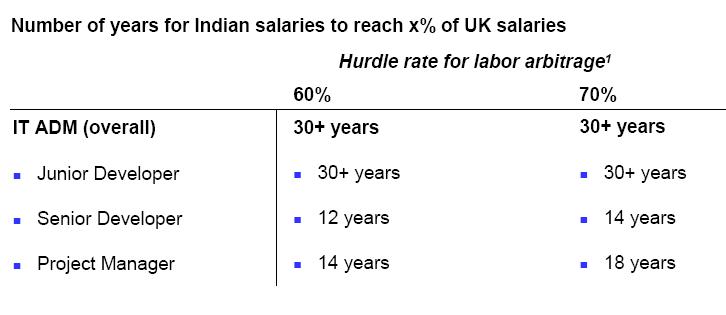
A recent 2006 Global Sourcing Market Update by Everest has brought to light that India will maintain its low-cost IT skills advantage in the offshoring market for at least another 30 years.
The update claims that fears of rapid wage inflation and skills shortage quickly reducing India’s offshore cost advantage are “greatly exaggerated.”
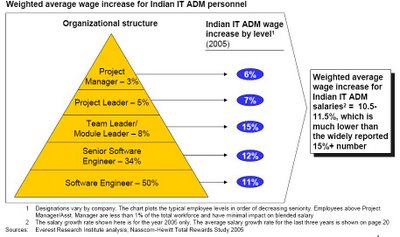
A recent 2006 Global Sourcing Market Update by Everest has brought to light that India will maintain its low-cost IT skills advantage in the offshoring market for at least another 30 years.
The update claims that fears of rapid wage inflation and skills shortage quickly reducing India’s offshore cost advantage are “greatly exaggerated.”

verest Research Institute conducted the sustainability analysis using a three-step approach.
1. In-depth Illustration: analyzed the sustainability of labor arbitrage for offshoring of select processes from UK to India
2. Generic analyses: explored expected labor arbitrage sustainability among a comprehensive list of source-destination country pairs
Source countries: US, UK, France, Germany, Japan
Destination countries: Indian, China, Philippines, Czech Republic, Poland, Mexico
3. Sensitivity to variations in key factors
Methodology takes into account that there are multiple factors affecting the longevity of labor arbitrage.
1. Current wage Diffential
2. Compensation increase in SOURCE Country
3. Compensation increase in DESTINATION Country
4. Exchange rate movements
5. Wage differential hurdle rate
Low-cost offshore locations such as India and the Philippines are aggressively making moves to minimize the impact of wage inflation by encouraging the expansion of the quality and size of the relevant workforce and by developing more low-cost offshore locations, states the report.
IT suppliers in India, for example, are lowering their costs by moving to Tier 2 cities — away from traditional high-tech centers such as Bangalore — and opening delivery centers in other countries.
for more information and full report visit www.outsourcingcenter.com
Tuesday, May 30, 2006
INSURANCE BPO IN INDIA
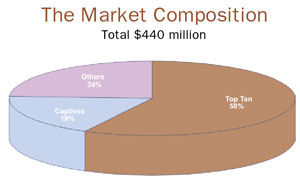
Major Insurers Who Have Outsourced to India :
AA Insurance ... Aetna ... Abbey Insurance Services ... Admiral Insurance ... Allianz Cornhill Captive ... Aviva ... Axa Captive ... BCBS companies (a few) ... BUPA ... Cigna ... CNA ... Conseco ... Friends .... GE Financial ... Genworth ... MetLife ... Pacific Care ... Principal Group ... Prudential Financial US ... Prudential UK Captive ... Sentera Sesame (MIFAS) .... Standard Life .... Swiss Re Captive ... Royal/Sun Alliance ... UnitedHealth ... WellPoint .... WillisCAPTIVE .... Zurich Re ...
Top Employers ( Insurance BPO India )
Rank ... Company ... Employees
1 Lason India 2603
2 EXL* 2450
3 WNS 215
4 Gecis 1800
5 AXA* 1800
6 ICICI Onesource 1790
7 Hinduja TMT 1500
8 MphasiS BPO 1500
9 24/7 Customer 1400
10 Prudential* 1000
11 Wipro BPO 1000
*Source: Global Services
Monday, May 29, 2006
Study Finds Direct Correlation Between Satisfaction and Investment In Outsourcing Management
According to a study by EquaTerra, there is a direct relation between a satisfactory outsourcing agreement and that of investments made in Outsourcing Management and Governance (OM/G).
The conclusion was based on a survey of 250 IT and BPO decision makers by the US-based outsourcing advisory firm. The firm advises a four to seven percent range in terms of the total value of contract as the optimum level of expenditure on OM/G to ensure maximum satisfaction on outsourcing deals. Executives outsourcing for process improvement than cost-savings are also expected achieve higher satisfaction levels. High-Tech Products and Services, Pharmaceuticals and Automotive/Manufacturing experienced the most satisfying results in terms industries while IT and CRM were the best verticals due to matured process.
The survey also finds that outsourcing satisfaction improves over time (respondents whose engagements had been in place more than two years were consistently more satisfied); IT and CRM executives cited the highest satisfaction levels.
While satisfaction was greatest for companies that spend 4%-7% on OM/G, over 48% of respondents spend between 1%-4%. Interestingly, HR executives were the least satisfied at this 1%-4% spend-level.
The study also indicates that organizations were using a wide range of software tools to support their outsourcing efforts. There was no clear consensus on which software applications or class of software vendors has the most compelling OM/G tools.
However, organizations clearly identified that value for the money and ease of use are the key desired functional attributes of a quality OM/G tool, and that providing timely, relevant and actionable data was the more important deliverable from an OM/G tool.
Source: Global Services, EquaTerra
According to a study by EquaTerra, there is a direct relation between a satisfactory outsourcing agreement and that of investments made in Outsourcing Management and Governance (OM/G).
The conclusion was based on a survey of 250 IT and BPO decision makers by the US-based outsourcing advisory firm. The firm advises a four to seven percent range in terms of the total value of contract as the optimum level of expenditure on OM/G to ensure maximum satisfaction on outsourcing deals. Executives outsourcing for process improvement than cost-savings are also expected achieve higher satisfaction levels. High-Tech Products and Services, Pharmaceuticals and Automotive/Manufacturing experienced the most satisfying results in terms industries while IT and CRM were the best verticals due to matured process.
The survey also finds that outsourcing satisfaction improves over time (respondents whose engagements had been in place more than two years were consistently more satisfied); IT and CRM executives cited the highest satisfaction levels.
While satisfaction was greatest for companies that spend 4%-7% on OM/G, over 48% of respondents spend between 1%-4%. Interestingly, HR executives were the least satisfied at this 1%-4% spend-level.
The study also indicates that organizations were using a wide range of software tools to support their outsourcing efforts. There was no clear consensus on which software applications or class of software vendors has the most compelling OM/G tools.
However, organizations clearly identified that value for the money and ease of use are the key desired functional attributes of a quality OM/G tool, and that providing timely, relevant and actionable data was the more important deliverable from an OM/G tool.
Source: Global Services, EquaTerra
Sunday, May 28, 2006
Sprint Files Lawsuit against IBM
BusinessWeek has reported that Sprint is suing IBM, saying Big Blue did not live up to its claims three years ago that it would save the telecommunications company money by taking over some of its computer programming.
Instead, Sprint said the deal ended up costing the company. It claims IBM Corp. now owes Sprint at least $6.4 million for 119,000 hours of uncompleted work - or 57 years for a single employee.
In a lawsuit filed this week in U.S. District Court in Kansas, Sprint/United Management Co. - a subsidiary of Sprint Nextel Corp. - said IBM didn't provide "contractually promised productivity improvements for 2005."
BusinessWeek reports that IBM, according to court documents, said Sprint is using an incomplete formula for measuring productivity and the amount of hours owed.
The suit focuses on a five-year, $400 million contract that went into effect in 2004. The deal, which was extended by a year, called for IBM to develop and oversee software applications for the Overland Park-based company.
Sprint transferred around 1,000 of its computer workers to IBM as part of the outsourcing agreement.
BusinessWeek has reported that Sprint is suing IBM, saying Big Blue did not live up to its claims three years ago that it would save the telecommunications company money by taking over some of its computer programming.
Instead, Sprint said the deal ended up costing the company. It claims IBM Corp. now owes Sprint at least $6.4 million for 119,000 hours of uncompleted work - or 57 years for a single employee.
In a lawsuit filed this week in U.S. District Court in Kansas, Sprint/United Management Co. - a subsidiary of Sprint Nextel Corp. - said IBM didn't provide "contractually promised productivity improvements for 2005."
BusinessWeek reports that IBM, according to court documents, said Sprint is using an incomplete formula for measuring productivity and the amount of hours owed.
The suit focuses on a five-year, $400 million contract that went into effect in 2004. The deal, which was extended by a year, called for IBM to develop and oversee software applications for the Overland Park-based company.
Sprint transferred around 1,000 of its computer workers to IBM as part of the outsourcing agreement.
Friday, May 19, 2006
ACS to Acquire Intellinex, LLC to Enhance Learning Solutions HRO Capabilities
Affiliated Computer Services, Inc. (NYSE: ACS), a premier provider of business process outsourcing and information technology solutions, announced today that it has signed an agreement to acquire Intellinex, LLC, an Ernst & Young LLP enterprise and leader in integrated learning solutions. The transaction is expected to close within 30 days and is subject to Hart-Scott-Rodino approval as well as other customary closing conditions.
"We expect all of ACS/Intellinex's customers, including Ernst & Young, will benefit from their combined knowledge and expertise," said Mike Hamilton, Americas Chief Learning and Development Officer for Ernst & Young LLP. "Ernst & Young was recently ranked third in Training magazine's Training Top 100, and we believe this transaction will allow us to focus even more of our efforts on the development and implementation of world-class learning content and programs for our people."
"Intellinex has demonstrated its value to our global organization through the services and technologies it offers," said Pierre Hurstel, Ernst & Young Global Managing Partner -- People. "Through its affiliation with ACS, I believe Intellinex will become even more effective in the delivery and implementation of our learning programs. I look forward to a continued relationship and am confident that the innovation and commitment Ernst & Young has received from Intellinex can only strengthen."
Ernst & Young LLP has entered into a multi-year learning services agreement with ACS/Intellinex to use its technology and administrative training support, as well as its learning design, to facilitate the delivery of the training content developed by Ernst & Young to its people.
Established in 2000 by Ernst & Young LLP, Intellinex has been recognized in the Leader Quadrant by the Gartner Group, most recently in its 2005 Learning Management System Magic Quadrant. More than 300 Intellinex employees at its headquarters in Cleveland, Ohio, and at locations in Irving, Texas, Lakewood, Colorado, and Europe, will become part of ACS when the transaction closes.
Visit www.Intellinex.com for more information
Affiliated Computer Services, Inc. (NYSE: ACS), a premier provider of business process outsourcing and information technology solutions, announced today that it has signed an agreement to acquire Intellinex, LLC, an Ernst & Young LLP enterprise and leader in integrated learning solutions. The transaction is expected to close within 30 days and is subject to Hart-Scott-Rodino approval as well as other customary closing conditions.
"We expect all of ACS/Intellinex's customers, including Ernst & Young, will benefit from their combined knowledge and expertise," said Mike Hamilton, Americas Chief Learning and Development Officer for Ernst & Young LLP. "Ernst & Young was recently ranked third in Training magazine's Training Top 100, and we believe this transaction will allow us to focus even more of our efforts on the development and implementation of world-class learning content and programs for our people."
"Intellinex has demonstrated its value to our global organization through the services and technologies it offers," said Pierre Hurstel, Ernst & Young Global Managing Partner -- People. "Through its affiliation with ACS, I believe Intellinex will become even more effective in the delivery and implementation of our learning programs. I look forward to a continued relationship and am confident that the innovation and commitment Ernst & Young has received from Intellinex can only strengthen."
Ernst & Young LLP has entered into a multi-year learning services agreement with ACS/Intellinex to use its technology and administrative training support, as well as its learning design, to facilitate the delivery of the training content developed by Ernst & Young to its people.
Established in 2000 by Ernst & Young LLP, Intellinex has been recognized in the Leader Quadrant by the Gartner Group, most recently in its 2005 Learning Management System Magic Quadrant. More than 300 Intellinex employees at its headquarters in Cleveland, Ohio, and at locations in Irving, Texas, Lakewood, Colorado, and Europe, will become part of ACS when the transaction closes.
Visit www.Intellinex.com for more information
Wednesday, May 17, 2006
| Dubai Outsource Zone to Start Operations by July ’06 | |
According to media reports, Dubai Outsource Zone (DOZ), a free zone for the outsourcing industry, is expected to be operational by July 2006. The zone is aiming to account for a 5 percent share in the global outsourcing industry and expects to have 200-300 companies in the first five years of its operation. The zone is targeted at the companies providing mid- to high-end IT and BPO services in sectors, including finance, accounting, IT, payroll processing, graphic design, engineering, biotech, R&D, and design. |
| Taiwan III Launches Offshore Development Center in India | |
The Institute for Information Industry (III), |
Monday, May 15, 2006
When Pearl, one of the UK's oldest insurers, hived off 950 jobs last month to an Indian outsourcing company, it could have been just another chunk of a historic industry disappearing offshore. After all, April had already seen announcements from Prudential and ABN Amro of hundreds more jobs to go in the UK financial sector, with India picking up the gains.
Tata Consultancy Services (TCS), Pearl's chosen outsourcer, has been clocking up the big deals of late. ABN Amro signed a £140m contract with the company in September to offshore 200 jobs, and Deutsche Bank is in final-stage negotiations to outsource even more in a deal worth at least £280m.
But the Pearl deal is different. Instead of shipping jobs to steamy Mumbai, TCS set up a joint venture with Pearl called Diligenta, and employees processing closed-book claims will remain at their desks in Peterborough.
Worth £486m over 10 years, the contract, which was first announced last October, is the largest-ever deal for an Indian outsourcer, and a potential IT deathtrap. Pearl has 11 legacy systems which TCS plans to combine before touting its solution to other insurers. "It's a very high-risk process," says Catherine Schmitt from research firm Celent. "A lot of the industry are holding their breath and saying 'let's see what happens'."
TCS hopes Diligenta will help it to woo a clutch of European insurers that are struggling with high operating costs but are culturally biased against sourcing out. "The UK has always been more open in insurance for offshoring but the Continental market is much more nationalistic," says Schmitt. "Tata is reacting to that by setting up an office in Hungary because there is less of an issue if you have a base in the EU."
TCS now has 4,500 employees outside India, and as the trend continues it will change how we define Indian companies, says Seturaman Mahalingam, the company's global finance director.
"If you look at the regional scene, in Europe we have capability in Budapest and in South America we have Sao Paulo. In Asia we are in China, Yokohama, and Melbourne, those kinds of places. So does that make us an Indian company? I don't know. What is an Indian company? IBM? They have 35,000 people in India. Accenture, with 16,000 people there? That distinction has blurred."
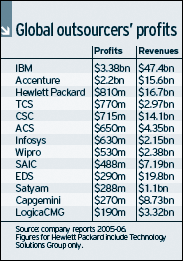
As befits an economy with 500m workers that is growing at 8pc a year, India's largest IT companies - the "big three" - are starting to bulk up. In recent results, Wipro and Infosys both reported revenues above $2bn for the first time while TCS's were just short of $3bn. The company's next target is to beat $10bn by 2010 with sales increasing 36pc a year. Not only are revenues growing, but Indian firms are doing it on margins of 25pc to 30pc, more than double those of mature players such as Accenture and IBM.
Of course, growing so fast presents its own problems. Last year TCS almost doubled its workforce by recruiting 27,377 people - 75 a day - and once took out 1,000 job ads in a single morning.
"There are issues," says Mahalingam. "For example the wages in India will go up. There is a tendency towards it already because it is a competition amongst everyone and everyone is recruiting." This has already driven up prices in the labour market, with IT wage inflation already at 10pc to 15pc a year. "And there will be currency appreciation because our functional currency is still the rupee. So there are dangers."
These dangers are the other force driving TCS's expansion on to Western shores. With costs at home going up, the company can now grow fastest by taking over existing workforces overseas. And as well as working with Indian university faculties to squeeze out more graduates, it is recruiting directly from prime British universities such as York and Queen's, Belfast.
The biggest prize for TCS is to break into higher-value business consulting work in the UK and US. Completing a blockbuster engagement like Pearl may get the firm on to a few more shortlists for this sort of work.
"I think people possibly underestimate TCS," says Schmitt. "There has been a lot of criticism of the Indian providers for being good at the technology but not really understanding the business, but that is changing. Companies like Accenture have moved down the value chain from highbrow strategy work to systems. The Indian guys are coming from a background as engineers and they are meeting and starting to compete in the middle."
Mahalingam responds to talk of the company's growing international recognition with a wry smile. He first came to the UK in the early Seventies to work on a systems migration job for Burroughs, and TCS has been quietly carving out a sizeable niche in systems here ever since.
"We have been here since 1974," he says. "It's just now, we are being noticed."
Tata Consultancy Services (TCS), Pearl's chosen outsourcer, has been clocking up the big deals of late. ABN Amro signed a £140m contract with the company in September to offshore 200 jobs, and Deutsche Bank is in final-stage negotiations to outsource even more in a deal worth at least £280m.
But the Pearl deal is different. Instead of shipping jobs to steamy Mumbai, TCS set up a joint venture with Pearl called Diligenta, and employees processing closed-book claims will remain at their desks in Peterborough.
Worth £486m over 10 years, the contract, which was first announced last October, is the largest-ever deal for an Indian outsourcer, and a potential IT deathtrap. Pearl has 11 legacy systems which TCS plans to combine before touting its solution to other insurers. "It's a very high-risk process," says Catherine Schmitt from research firm Celent. "A lot of the industry are holding their breath and saying 'let's see what happens'."
TCS hopes Diligenta will help it to woo a clutch of European insurers that are struggling with high operating costs but are culturally biased against sourcing out. "The UK has always been more open in insurance for offshoring but the Continental market is much more nationalistic," says Schmitt. "Tata is reacting to that by setting up an office in Hungary because there is less of an issue if you have a base in the EU."
TCS now has 4,500 employees outside India, and as the trend continues it will change how we define Indian companies, says Seturaman Mahalingam, the company's global finance director.
"If you look at the regional scene, in Europe we have capability in Budapest and in South America we have Sao Paulo. In Asia we are in China, Yokohama, and Melbourne, those kinds of places. So does that make us an Indian company? I don't know. What is an Indian company? IBM? They have 35,000 people in India. Accenture, with 16,000 people there? That distinction has blurred."
As befits an economy with 500m workers that is growing at 8pc a year, India's largest IT companies - the "big three" - are starting to bulk up. In recent results, Wipro and Infosys both reported revenues above $2bn for the first time while TCS's were just short of $3bn. The company's next target is to beat $10bn by 2010 with sales increasing 36pc a year. Not only are revenues growing, but Indian firms are doing it on margins of 25pc to 30pc, more than double those of mature players such as Accenture and IBM.
Of course, growing so fast presents its own problems. Last year TCS almost doubled its workforce by recruiting 27,377 people - 75 a day - and once took out 1,000 job ads in a single morning.
"There are issues," says Mahalingam. "For example the wages in India will go up. There is a tendency towards it already because it is a competition amongst everyone and everyone is recruiting." This has already driven up prices in the labour market, with IT wage inflation already at 10pc to 15pc a year. "And there will be currency appreciation because our functional currency is still the rupee. So there are dangers."
These dangers are the other force driving TCS's expansion on to Western shores. With costs at home going up, the company can now grow fastest by taking over existing workforces overseas. And as well as working with Indian university faculties to squeeze out more graduates, it is recruiting directly from prime British universities such as York and Queen's, Belfast.
The biggest prize for TCS is to break into higher-value business consulting work in the UK and US. Completing a blockbuster engagement like Pearl may get the firm on to a few more shortlists for this sort of work.
"I think people possibly underestimate TCS," says Schmitt. "There has been a lot of criticism of the Indian providers for being good at the technology but not really understanding the business, but that is changing. Companies like Accenture have moved down the value chain from highbrow strategy work to systems. The Indian guys are coming from a background as engineers and they are meeting and starting to compete in the middle."
Mahalingam responds to talk of the company's growing international recognition with a wry smile. He first came to the UK in the early Seventies to work on a systems migration job for Burroughs, and TCS has been quietly carving out a sizeable niche in systems here ever since.
"We have been here since 1974," he says. "It's just now, we are being noticed."
Subscribe to:
Posts (Atom)


