Monday, February 26, 2007

U.S., India Adjust Policies to enable greater trade in high technology

The U.S.A. and India agreed to begin adjusting their policies to enable greater trade in high technology, part of efforts to cement their fast-growing economic and political relations.

The U.S.-India High Technology Cooperation Group produced plans to ease U.S. export controls for selected Indian buyers, while tightening India’s regime governing exports of industrial items with military applications, US Assistant Secretary of Commerce Christopher Padilla told reporters.

The United States is committed to “clear up the Cold War cobwebs” of U.S. curbs on dual-use technology that imposed restrictions on pro-Soviet India, he said after the two-day meeting of government officials and business executives.

Washington has identified Indian technology companies that will be eligible for the U.S. “Trusted Customer Program” of streamlined or waived licensing requirements for buyers with good records of compliance with nonproliferation treaties.

India would be included in a program, proposed last year and under U.S. governmental inter-agency review that will also cover China and other states, Padilla said. To facilitate trade in chemicals, military supplies and other technology, Washington presented lists to New Delhi of products for which it wants India to bring its policies in line with international anti-proliferation standards.

Experts from the two countries would meet in several months and conduct a
“product-by-product comparison of the Indian control lists with the four major multilateral control regimes,”
Padilla said.

India’s policies on exports of nuclear technology and missiles were getting close to those of the Nuclear Suppliers Group and the Missile Technology Control Regime, he said.

India was also moving closer to harmony with the controls of the Australia Group, which aims to prevent chemical and biological materials from being sold to countries or others that would use them in weapons, said Padilla.

New Delhi still needed to close large gaps in its policies with those of the Wassenaar Arrangement, which governs dual-use items and conventional weapons, he added.

The United States and India dramatically advanced their relations in 2005 when visiting Indian Prime Minister Manmohan Singh and President George W. Bush signed a host of agreements, including a deal that, when finalized, would allow US sales of civilian nuclear equipment and fuel to India.

via: Globalservicesmedia

Thursday, February 22, 2007

Russian ITO Market to Grow by 40%-50% in 2007: neoIT


In 2007, Russian Information Technology Outsourcing (ITO) market will grow by 40%–50%, says a study by neoIT — a management consulting firm. Russia is currently the third largest IT outsourcing supply market, behind India and China. Russian IT companies are specialized in high-end software and embedded software product development, which acts as a differentiator from lower-priced offerings from Indian companies, according to the research.

The study predicts the key trends for 2007. The key trend this year is business transformation, which global companies will leverage to improve time-to-market, gain new business, standardize processes and significantly lower costs.


“Business transformation through services globalization is one of the most important levers that global companies can no longer afford to ignore,”
stated Atul Vashistha, CEO, neoIT.
“We see the services globalization industry continuing to grow at a brisk rate of 25%–30% in the coming year, as more and more companies ramp up their services globalization initiatives.”
The new report looks at the factors that contribute to the growth in services globalization and identifies several trends. The report also takes an in-depth look at the impact that the increasing number of sophisticated buyers, who now have several years of global sourcing experience, will have on the industry.

On the supplier side and perhaps more relevant for Indian companies, the report says, competitive forces are leading to increased supplier sophistication. The year 2007 will see an increased focus among service providers on developing industry-specific subject matter expertise through acquisitions. In fact, acquisitions will be a continuing trend in 2007 with the report saying that Eastern companies will acquire Western outfits to gain a global footprint and venture into services that demand a significant onshore presence. The companies based in the West will take a keen interest in setups in the East to stay competitive as well as explore eastern markets, which are not only cost effective delivery locations, but also rapidly emerging markets by themselves. Geographically, new locations are emerging, although India will continue to lead the supplier market, with Europe showing strong growth.

The research brief also predicts that billing rates will go up amongst the Tier 1 suppliers by two to three percent due to the growing demand for skilled resources, rise in wages and increased overheads incurred in maintaining quality or ensuring tight security.

The report also says that despite the ongoing debate about Tier 1 versus Tier 2 cities and concerns of wage inflation, attrition and infrastructure issues, Indian Tier 1 cities (NCR, Bangalore, Chennai, Hyderabad and Mumbai) will grow at a continued pace in attracting offshore delivery work, through 2007. The European market for global services is also expected to grow at a faster rate with European companies offshoring to India, China and the Philippines and other lower-cost locations, depending on the language and culture-dependence of the particular service.

Source: NeoIT, Global Services Mag

Monday, February 19, 2007

Remote Infrastructure Management Outsourcing (RIMO) Market Growth to Exceed US $8 Billion over Next Five Years

The Remote Infrastructure Management Outsourcing (RIMO) market is likely to exceed US $8 billion over the next five years, according to a new report released today by the Everest Research Institute.

The RIMO market, an emerging Infrastructure Outsourcing (IO) model, is growing at approximately 60 percent annually. According to the Infrastructure Outsourcing Roadmap report, 75 percent of this growth is attributed to renewals of pilot contracts with significant scope increases with the remaining 25 percent is attributed to new deals. The Roadmap report also provides insights into the benefits of RIMO for buyers, such as enhanced flexibility in IT asset ownership arrangements and increased control over IT service delivery, as well as discusses suppliers’ challenges in meeting these new trend demands. The report is the first of a series of four studies to be released this quarter by the Institute’s newly formed ITO Research Group, established to analyze the ever-changing ITO marketplace in greater depth and provide actionable insights into its future evolution.

“While the Infrastructure Outsourcing market appears calm on the surface and is growing in line with the overall IT industry,”
said Ross Tisnovsky, Vice President, ITO Research Group,
“there are significant structural changes in the market itself that are driven by emergence of new technologies in infrastructure and fundamental changes in the IT asset ownership dynamics.”


The report series will progressively build the picture of the IO market trends and dynamics through analyses of the effects on key market stakeholders relative to four key market developments:
(1) arrival of the labor arbitrage in the IO market;
(2) changes in the asset ownership dynamics;
(3) emergence of new business models in IO; and
(4) emerging global locations for offshore infrastructure management delivery.

The first report, Infrastructure Outsourcing Roadmap, revisits the IO market history and reviews the prevalent business models in this market (traditional outsourcing, managed services and RIMO). After an examination of the fundamental drivers of the new models, such as RIMO, the study describes the entry of the offshore suppliers and their approaches to the market’s growth. The report also discusses the economic rationale behind traditional and RIMO models of service delivery, defines the impact of labor arbitrage, and offers a balanced view of the growth prospects and next steps for the market constituents.

Following the Roadmap report, forthcoming reports this quarter from the Institute’s ITO Research Group are:
  • “Asset-light Outsourcing Model” will offer insights into one of the most important drivers of changes in the IO market – the IT asset ownership trends in an infrastructure outsourcing deal. The report will cover the historical reasons for asset ownership transfer in the IO deals and changes in the ITO landscape, which have prompted buyers to reconsider their asset ownership strategies. This report will also examine the decoupling of asset control from asset ownership requirement through remote management tools, the emergence of third-party financing alternatives, and looming changes in accounting that will further decrease the benefit of asset ownership transfer.

  • “Growth of Infrastructure Management Outsourcing” will predict growth scenarios for RIMO market and outline effects on the overall IO market. The report’s findings will be gleaned from an analysis of key market forces shaping the IMO marketplace that determine IMO growth prospects, as well as an outline of the Institute’s growth model for the RIMO space that incorporates the effects of key market forces and defines a mathematical model of key signing and renewal dynamics in the RIMO market.

  • “Selecting a Location for Remote Infrastructure Management Service Delivery” will provide a high-level view of the emerging global locations for offshore infrastructure management service delivery and identify the most attractive cities in pre-selected geographies by utilizing the Institute’s proprietary location selection methodology.

Tuesday, February 13, 2007

ChrysCapital to Sell Global Vantedge BPO to ACG

According to media sources, ChrysCapital, an Indian private-equity firm, and other shareholders are expected to sell their respective stakes in Global Vantedge, a US-headquartered credit and receivable management BPO services provider, to Aegis Communications Group (ACG), a US-based CRM BPO services provider, for about INR 1 billion.

Chrys Capital holds a 75 percent stake in Global Vantedge. The BPO firm has been offering credit and receivable management services to various clients including credit card companies, telecom operators, and auto companies catering primarily to the US and UK markets through its two Gurgaon-based centers in India since 2001.

Aegis has been operating from its 24 centers across the world offering a wide range of CRM services including customer acquisition and customer services, back-office services, and value-added services catering to the telecom, retail, financial services, energy, education, and logistics verticals. It employs about 9,000 professionals in India and the US.

Monday, February 05, 2007

About 80% Clients Satisfied with BPO Operations
NASSCOM-McKinsey

According to a study conducted by NASSCOM-McKinsey titled, ‘Operational Excellence: The Next Frontier in Offshoring’, about 80 percent of clients are satisfied with the performance of BPOs. The study is in continuation of the two companies’ report regarding India’s ability to generate about USD 60 billion from IT/BPO export.

In addition, the pressure on various offshore companies is likely to increase due to high expectations from clients. Among the key findings, the study indicates that there is scope for various BPO firms to reduce cost by about 20-30 percent, and for IT firms to increase EBIT margins by about 3-6 percent.

In the BPO domain, the priorities of clients will shift towards other benefits, such as innovation and productivity, once the offshore services are well established. In addition, there is a lack of consistent performance across various companies due to inadequate recruiting practices. Owing to high retention rates, the performance of data-based operations is better than voice-based processes.

However, in the IT domain, the IT service providers are estimated to improve performance and consistency across six practice areas, including requirements gathering, solution design, and training. Despite client satisfaction and strong outcomes, inconsistencies are reported in issues, such as solution design, training, and recruitment. There has been a significant increase in clients seeking upstream services such as requirements gathering and solution design. At present, these services are not strong enough to competently meet a client’s demands. The leading IT performers are expected to increase salaries in the range from 15 percent to 18 percent, without impacting their profit margins.

According to Kiran Karnik, President, NASSCOM, India is the leader in the global offshoring market with about 50 percent market share. Companies need to focus on operational excellence to achieve the target of USD 60 billion from IT/BPO export revenues by 2010.

Monday, January 29, 2007

Pharma Firms to Expand Outsourcing Scope : EquaTerra

According to a report, ‘Outsourcing trends in the pharmaceutical industry’ by EquaTerra, about 44 percent of the pharmaceutical companies that have already outsourced one or more IT or BPO services are likely to outsource a few more functions, including HR and finance, during 2007. While the primary reason for IT outsourcing is cost reduction, BPO services also help to improve costs as well as processes.

Among the key findings, while about 39 percent of the pharmaceutical companies are planning to outsource their activities to new geographies or business units and about 22 percent are likely to expand their existing outsourcing activities. The firm also reported that none of the companies are planning to reduce their outsourcing activities.

The organization also confirmed that IT is the most common process that is being outsourced by pharma companies. About 72 percent of the pharmaceutical firms are already outsourcing their IT services, while the others are either planning to or have no intention to outsource. In addition, the survey claimed that business process functions, such as call centers, finance, and human resources in the pharma industry are still in the nascent stage and are expected to mature gradually.

In the BPO domain, the most common processes which are outsourced in the pharma domain include call center or CRM services. The report also highlighted the increase in outsourcing activities in clinical trials, R&D of new drug, and developing drugs in the future.

Thursday, January 25, 2007

Indian IT-ITeS ‘07 Export Revenues Expected to Increase 32.6% to $31Bn – NASSCOM


According to a study by NASSCOM, an Indian IT and BPO industry trade lobby, export revenues of the Indian IT- ITeS industry for FY 2007 are predicted to increase at a rate of 32.6 percent to reach USD 31.3 billion as compared to USD 23.6 billion (an increase of 33.3 percent) in FY 2006. In addition, the total IT industry, including hardware sales, is predicted to reach about USD 47.8 billion in FY 2007 and USD 100 billion by FY 2010.

The IT industry is forecasted to contribute about 5.4 percent to the GDP of the country in FY 2007 as compared to 4.8 percent in FY 2006. A recent study of India’s IT and BPO sector, conducted by NASSCOM and McKinsey, predicted that the industry to be worth USD 60 billion by 2010. The current NASSCOM estimates are in line with the prediction. NASSCOM also predicts that the software exports will be required to grow at a CAGR of 24.2 percent for the next four years in order to achieve the target.

In addition, NASSCOM expects that the employment level in India’s software and services sector will reach the 1.6 million mark in FY 2007, representing a growth of 26 percent over the previous year. The export services contributing to the growth of the IT industry are expected to account for USD 18.1 billion in the FY 2007. The UK and the US were the largest market for exports in FY 2006. The Americas accounted for about 67 percent, Europe for 25 percent, and rest of the world for 7.7 percent.

Among other key findings, the domestic IT industry is anticipated to grow by 21 percent to generate revenues worth USD 15.9 billion in the fiscal year, with the software and services segment accounting for majority of the growth. The domestic hardware will contribute USD 7.6 billion, while USD 5.6 billion is expected to be attributed by services, followed by USD 1.6 billion from software and USD 1.2 billion by the BPO sector. MNC investments over the next few years are expected to exceed USD 10 billion for FY 2007.
Outsourcing grows up

Many outsourcing deals are tantamount to strategic divestitures and joint ventures. Executives should start treating them that way.

Read the McKinsey Quarterly article, Pretty OLD, but interesting

http://www.mckinseyquarterly.com/article_page.aspx?ar=1582&L2=5&L3=4

Monday, January 22, 2007

About 3.3% US IT Budgets to be Spent on Offshoring in ‘07 – SIM

According to a study by the Society for Information Management (SIM), a Chicago-based professional society of IT executives, about 3.3 percent of the IT budget will be spent on offshore projects in 2007 in the US, while about 9.3 percent of the IT budget is expected to be spent on domestic outsourcing.

In addition, about 66 percent of the respondents stated that they will not spend their IT budgets for outsourcing in 2007. Many companies are planning to establish in-house IT support infrastructure and are expected to spend about 33 percent of their IT budgets for training IT staff. Most of the IT professionals favored domestic outsourcing over offshoring. The companies providing IT support to various firms located in London are expected to gain more business, including outsourcing of IT infrastructure and applications, from the capital.

Thursday, January 18, 2007

Demand for Outsourcing Growing Slowly – EquaTerra


According to EquaTerra 4Q 2006 Outsourcing Pulse Surveys, the demand for outsourcing in the BPO and ITO market is growing at a slower pace as compared to the growing rate of earlier years. The organization reported that there has been a decrease of about 13 percent in the last quarter of 2006 as compared to 3Q 2006 and 4Q 2005.

Among the key findings, the non-traditional functions, such as document and imaging services, legal processing, knowledge process, and logistics services outsourcing increasingly depends on both supply and demand. Also, there has been an increase in the multi-provider outsourcing that allows the client to have the best for each of its process. However, the multiple services provider model can be ranked as complicated as well as expensive as compared to outsourcing services to the single services provider.

In addition, most of the clients outsourcing their processes underestimate the cost and complexity related issues while performing Outsourcing Management and Governance (OM/G) activities, including the governance organization’s staffing, the costs related to the third-party services, such as lawyers, advisors, etc., and the costs related to the software support for OM/G activities. The above mentioned reasons are often considered as one of the root causes for problems related to outsourcing.

According to Stan Lepeak, Managing Director – Research, EquaTerra, most of the outsourcing contracts awarded during the late 1990s and early 2000s were not structured properly, which used to create problems either for the service providers or clients.

Wednesday, January 17, 2007

Everest Research Institute Study Predicts 30% Finance & Accounting Outsourcing Growth in 2007
Finance & Accounting Outsourcing Market Surpasses $2 Billion in Expenditure in 2006 with 45% Annual Growth

The global Finance and Accounting Outsourcing (FAO) market is predicted to grow in excess of 30 percent in 2007 as the global infrastructure matures to enable F&A solutions that take advantage of low-cost offshore talent and robust supplier process offerings underpinned by F&A technology, according to a new report released today by the Everest Research Institute.

The global FAO market has grown by more than 45 percent since the beginning of 2005 and reached $2 billion in expenditures in the United States last year, according to the Institute’s Finance & Accounting Outsourcing (FAO) Annual Report 2006. The study reports North America-based contracts continue to account for over half of FAO revenues, with increasingly rapid growth in Continental Europe. Among the industry verticals, manufacturing and energy and utilities are leading the FAO adoption, capturing nearly 50 percent of the market. Retail and financial services are the most under-penetrated sectors with high untapped demand.


“Our analysis reveals that the number of multi-process FAO contracts signed doubled between 2004 and 2006,”
said Phil Fersht, vice president, BPO Research Group at the Everest Research Institute.
“We expect that existing buyer success stories, suppliers’ investments in further developing F&A process capabilities and a global footprint will drive growth in the near future.”
The FAO annual report for 2006 activity examines the global FAO market and provides insights, detailed analyses and implications for stakeholders along three key dimensions:
(1) market size and buyer adoption,
(2) transaction characteristics and value proposition and
(3) supplier landscape.

The report found that offshoring is now established as the key value lever in FAO with more than 80 percent of all contracts including an offshore component. While India has emerged as the premier offshore destination with the largest number of scaled FAO centers, Eastern European locations are also becoming an integral part of supplier strategy to support European operations.

Regarding supplier activity, the report suggests that the FAO industry is witnessing an increasingly level playing field. In 2006, Genpact, HP, Infosys BPO, and Xansa significantly increased their market share. Accenture, IBM, ACS, and Genpact currently lead the market on a capability market success matrix, but there is still an intense battle for overall market share.
“The leading suppliers are looking to expand their global delivery capabilities through the acquisition of both captives and existing shared-service centers,”
said Fersht.
“Moreover, we expect further acquisitions of smaller FAO suppliers from the global leaders, and increased partnering with niche suppliers to fill out capability gaps. Several leading FAO suppliers are also looking to broaden their offerings with increased bundling across ITO and procurement services.”

The Institute also reported that despite the phenomenal growth over the past few years, the FAO market is grossly under-penetrated across all regions and verticals, and there is still substantial opportunity for growth.
“The market is now experiencing an aggressive growth phase fueled by cost reduction from offshoring and the adoption of multiple accounting processes integrated within a single outsourcing provider,”
said Saurabh Gupta, senior analyst, and co-author of the report.
“Innovation in F&A is taking center stage as FAO is creating incremental value for new and existing buyers by creating both a business and strategic impact, supported by a streamlined, low-cost sourcing infrastructure.”

For additional information and samples from the report, please visit www.outsourcing-center.com and select the link, FAO Annual Report 2006.

Monday, January 08, 2007

Convergys has acquired AOL contact center in Albuquerque, New Mexico, from Time Warner. The call center employs about 800 employees. Convergys has already started its operations from the facility in New Mexico. The company aims to recruit more employees for the center from Albuquerque city and is also planning to expand its presence in the US by opening new call centers in the country. AOL has been planning to close the center as a part of restructuring. The company's business has been affected by losing most of its clients; and also helpdesk calls have been reduced to about half the number.
Yahoo! has announced its plans to open a research lab at Bangalore, India. The company plans to have R&D centers globally to deliver next generation of businesses. It also has centers in other locations, including four facilities in the US, one in Spain and in Chile. The company has already initiated the recruitment process to acquire scientists from diversified fields, including computers, sociology, economics, and other related fields, for the new center. In addition, it also operates an R&D center in Bangalore employing about 700 professionals, including developers and researchers.

Friday, December 01, 2006

Deloitte to Increase Indian Headcount


Deloitte Touch Thomatsu, a New York-based accounting services provider, has announced its plans to increase its Indian headcount from the present 7,500 to 12,000 professionals by 2010. According to Manoj Singh, CEO–APAC, Deloitte, the company is planning to invest about USD 50 million by 2010.

According to William G Parrett, CEO, Deloitte, the company has offices in about 13 locations across India and the company is investing in personnel, technology, and infrastructure sectors in the country and Asia Pacific region. The company provides various services, including audit, tax, consulting, and financial advisory services.

Tuesday, November 21, 2006

After the BPO and telecom consolidation, various small firms in the Knowledge Process Outsourcing (KPO) industry are expected to merge with each other by 2008. At present, the KPO industry is worth about USD 650 million, as compared to USD 400 million in 2005.

According to a Frost & Sullivan report, KPO is expected to be a USD 32.5 billion industry by 2014 and will employ about 4,00,000 professionals with a CAGR of about 63 percent. The industry employs about 10,000 professionals currently. The KPO industry provides services to various verticals such as financial services, retail, manufacturing, telecom, and healthcare services. In addition, the KPO industry is likely to have a shortage of skilled professionals in the next few years.
Westpac Drops Outsourcing Plans to India

The Australia-based Westpac Banking Corporation has dropped its decision to offshore about 300 administrative jobs to India from its Concord West-based transactions and unsecured lending operations center. The center processes dishonored checks, electronic payrolls, Internet banking, and deceased estates. According to a statement by Westpac, the offshoring proposal did not meet their financial and stakeholder criteria.

The bank also reported that offshoring would not save as much as estimated earlier. The outsourcing plan would have affected about one-third of the center’s 1,000 member staff. The Finance Sector Union of Australia had earlier stated that about 50,000 jobs of the industry’s 280,000 jobs could be offshored.

Friday, November 10, 2006

US HRO to reach USD 19 Billion

According to a report titled, 'Worldwide and US HR BPO 2006 Vendor Analysis: The Answer is in the Margin' by IDC, the HR BPO segment of US HR services will grow at a CAGR 16 percent to reach USD 18.9 billion by 2010.

It also reports that with the growth in the HR BPO segment, the obstacles for the new entrants in the market will also increase. However, the trend might change in the future with the entry of new Indian HR firms. The major reason for the growth of HR BPO services is that most companies, including the mid-sized companies, are aiming at global recognition. As a result, most of the firms are establishing their operations outside their headquarter country. Among the key findings, about 37 percent of the US HR services spend in 2004 was spent on HR BPO services and is expected to reach 46 percent by 2010.


via: GlobalOutsourcingNow

Sunday, October 29, 2006


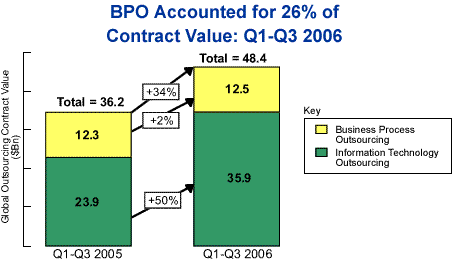
Source: Nelson-Hall study

Wednesday, October 18, 2006

BPO Sector in 3Q ’06 on the Rise – NelsonHall

NelsonHall, a US-based BPO analyst firm, has reported growth in the BPO sector contracts. The level of BPO activities is more in Europe as compared to North America. Europe showed an increase of about 36 percent, while North America reported a decrease of 26 percent, in the first nine months of 2006.

The major reasons for this increase in the BPO market include the outsourcing of HR, F&A, and procurement services. The value of about 36 percent of BPO contracts depended on the types of the services provided by the company in the quarter ending September 2006, as compared to 24 percent in the corresponding year-ago period. The BPO contract value for the back-office services has increased by 36 percent, as compared to the decrease in the industry-specific services contract value by 28 percent by the end of September 2006.

The BPO contract value of outsourcing HR, F&A, and procurement services accounted for 40 percent in North America, as compared to 31 percent in Europe by the end of September 2006. The manufacturing and retail BPO contracts accounted for 27 percent by the end of September 2006, as compared to 13 percent in the corresponding year-ago period.


Source: GlobalOutsourcingNow