After targeting India and the Philippines as the prime destinations for offshoring technology and call-center jobs, major US companies are increasingly looking towards Latin America to meet their 'nearsourcing' requirements. Dell and Procter & Gamble (P&G) are some of the major MNCs heading to the Latin American countries to source such services.
According to Federico Cartín, Executive Director, Costa Rican Chamber of Information and Communication Technology (ICT), the number of call-center positions alone is expected to double in the next two years.
As per Datamonitor figures, the number of call-center workstations in the Latin American region as a whole will touch 730,000 in 2008, up from 336,000 in 2004. One of the prime reasons for the attractiveness of these destinations is the lesser geographical distance, as compared to prime offshore destinations.
reported by eValueserve.com
Friday, September 16, 2005
Monday, August 29, 2005
Tuesday, August 23, 2005

What's Driving India's Rise as an R&D Hub?
What forces are shaping these trends? What does the future hold? To answer these questions and more, Knowledge@Wharton collaborated with the Economic Times Intelligence Group in Mumbai, India, on this special report on R&D in India.
Read the articles
- just sharing the knowlede - kiss goodbye the copyright acts -
Saturday, August 13, 2005
GE to Hire 500 at India Outsourcing Unit
Gecis, a JV between GE and private equity firms General Atlantic and Oak Hill Capital Partners, will hire 500 more people at its Western Indian center at Jaipur. The additions would take the total staff strength at the center to 1,500 by early 2006.
In addition, the company will also invest INR 750 million to set up a new facility in Jaipur. According to Pramod Bhasin, President and CEO, Gecis Global, the company serves some major global clients from the Jaipur center. He added that Jaipur center is the fastest growing site for the company worldwide.
The Jaipur center provides services in the areas of accounting, accounts receivables, customer service and technical support to both GE and non-GE customers in the US, UK and various other European countries. The center caters to industries such as commercial banking, consumer banking, corporate financial services and computer manufacturing.
-Reported by Market Watch-
Gecis, a JV between GE and private equity firms General Atlantic and Oak Hill Capital Partners, will hire 500 more people at its Western Indian center at Jaipur. The additions would take the total staff strength at the center to 1,500 by early 2006.
In addition, the company will also invest INR 750 million to set up a new facility in Jaipur. According to Pramod Bhasin, President and CEO, Gecis Global, the company serves some major global clients from the Jaipur center. He added that Jaipur center is the fastest growing site for the company worldwide.
The Jaipur center provides services in the areas of accounting, accounts receivables, customer service and technical support to both GE and non-GE customers in the US, UK and various other European countries. The center caters to industries such as commercial banking, consumer banking, corporate financial services and computer manufacturing.
-Reported by Market Watch-
Financial Firms Looking at End-to-End Outsourcing
According to a new study by Datamonitor, a UK-based market research company, there would be changes in the way European financial services companies outsource horizontal business processes, such as HR, finance, accounting and procurement.
Analysts predict that as compared to the previous options when tasks where outsourced on an individual basis, the current trend is towards setting up centralized services and integrated end-to-end functions.
Financial services firms are becoming more motivated to consider this kind of BPO arrangements as complexity increases for tasks such as accounting and procurement, in large part due to the need to comply with new laws and regulations.
Analysts add that the move towards comprehensive horizontal BPO in financial services is also coming about, because vendors are increasingly getting better at providing end-to-end services. BPO vendors have also increased in size and gained a greater range of competencies after the recent wave of mergers and acquisitions. IT services companies, too, are moving into the BPO space through acquisitions.
Procurement is set to become the fastest growing BPO function over the next three years, as it is a good fit for the efficiency drive characteristic of financial services firms.
- Reported by silicon.com-
According to a new study by Datamonitor, a UK-based market research company, there would be changes in the way European financial services companies outsource horizontal business processes, such as HR, finance, accounting and procurement.
Analysts predict that as compared to the previous options when tasks where outsourced on an individual basis, the current trend is towards setting up centralized services and integrated end-to-end functions.
Financial services firms are becoming more motivated to consider this kind of BPO arrangements as complexity increases for tasks such as accounting and procurement, in large part due to the need to comply with new laws and regulations.
Analysts add that the move towards comprehensive horizontal BPO in financial services is also coming about, because vendors are increasingly getting better at providing end-to-end services. BPO vendors have also increased in size and gained a greater range of competencies after the recent wave of mergers and acquisitions. IT services companies, too, are moving into the BPO space through acquisitions.
Procurement is set to become the fastest growing BPO function over the next three years, as it is a good fit for the efficiency drive characteristic of financial services firms.
- Reported by silicon.com-

HR Outsourcing - Trends & Insights 2005
Hewitt Study on the Trends and insights of HRO was conducted during the forth quarter of 2004 and first quarter of 2005.
One hundred Twenty-nine employers responded to the survey, of which 121 (94%) outsource atlast one HR Function.
Participants' employee population average 15,798 employees with a median of 7500. Just over one third have populations under 5000.
Nearly one third have populations ranging from 5000 to 9,999 employees, and one-third have population in excess of 10,000 employees.
Participating organizations represent a wide range of industries and have annual revenues ranging from just under $ 1 Million to $45 Million , averaging $6.1 Billion with a median of $ 2.2 Bn.
Click here to download the higlights of the survey.
Click here to download the higlights of the survey.
-
Friday, August 12, 2005
Satyam to Take BPO to Indian Villages
Satyam Computers, an Indian IT and BPO services, will launch a program under its GramIT [ village IT ] project to spread the BPO trend to the rural areas of the country. The project will utilize the rural population to provide low-end BPO services. Satyam is one the most prominent Indian companies to have benefited from the offshoring trend.
The GramIT or village IT centers will have access to the rural human resources at the lowest possible cost. According to Ramalinga Raju, Chairman, Satyam Computer, such facilities will be set up across 150 villages over a period of time. The first such center has already been set up in one of the remote village in the southern Indian State of Andhra Pradesh.
Satyam will also become the first customer of the GramIT project and will outsource its internal processes concerning HR, such as book keeping, computerization of bio-data’s among other actives. The company has also undertaken the responsibility of training the rural population to make them eligible to work in these village ITeS center.
Reported by Business Standard
TCS to Start KPO Services
Tata Consultancy Services (TCS), the Indian IT solution company, is planning to start providing Knowledge Process Outsourcing (KPO) services as part of its BPO operations.
The company intends to begin the services alongside its BPO businesses in Bombay and Chennai, with focus on analytics and research.
Talking about the move, N Chandrasekaran, Executive VP and Head-Global Operations, said, “Our KPO solutions will provide customers a synergistic combination of deep domain expertise and strong operational excellence.”
TCS officials added that the KPO initiative would be positioned at the higher end of value chain and would provide services to global investment banks, mutual funds, hedge funds, insurance firms and other financial services companies across the globe. However, the company did not disclose its investment plan.
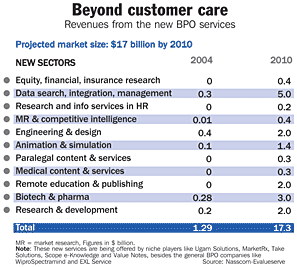
The global KPO industry is expected to touch USD 17 billion by 2010, of which USD 12 billion would be outsourced to India providing employment to over 250,000 professionals from the current 25,000 professionals.
- Reported by Business Standard -
.
Tata Consultancy Services (TCS), the Indian IT solution company, is planning to start providing Knowledge Process Outsourcing (KPO) services as part of its BPO operations.
The company intends to begin the services alongside its BPO businesses in Bombay and Chennai, with focus on analytics and research.
Talking about the move, N Chandrasekaran, Executive VP and Head-Global Operations, said, “Our KPO solutions will provide customers a synergistic combination of deep domain expertise and strong operational excellence.”
TCS officials added that the KPO initiative would be positioned at the higher end of value chain and would provide services to global investment banks, mutual funds, hedge funds, insurance firms and other financial services companies across the globe. However, the company did not disclose its investment plan.
The global KPO industry is expected to touch USD 17 billion by 2010, of which USD 12 billion would be outsourced to India providing employment to over 250,000 professionals from the current 25,000 professionals.
- Reported by Business Standard -
.
Thursday, August 11, 2005
Its MONEY Honey ....
A Deloitte Research report indicates that India's biggest challenge in the short-term, ironically, is its own success. While on one hand wage inflation is retarding India's potential in terms of cost competitiveness, a rapid growth in off-shoring is creating a shortage of qualified labour.
Faced with the rise in salary bills, Indian suppliers have started sub-contracting their routine processes to China to capitalise the prevailing lower wage rates there.
Salary hikes in India, which in 2003 were in double digits, far outpace the global average.
Increasing demand for offshoring is driving wages up, thereby reducing the potential cost savings.
Last year, according to Deloitte research, more than half of India's IT employees received at least a 10 per cent salary hike with the top 10 per cent of the workforce receiving an average rise of more than 40 per cent.
In contrast, most IT employees in the US received a salary rise of five per cent or less. Salaries for call centre staff have risen by 25 per cent over the past 12-18 months in India.
Though salaries in the US are still, on an average, nearly 10 times higher than those in India ($80,286 versus $8,593), the gap is sure to diminish over time. "India is by far the most popular offshoring location and is currently the default choice both in the communication sector and elsewhere. We expect this will change over time," the report said.
At the same time, the global research outfit has predicted that by 2008 the global communication industry alone will employ more than 275,000 people nearly representing five per cent of the industry's projected global workforces.
Staff turnover is a growing concern and local companies are finding it difficult to recruit qualified workers.
"One common approach for starting a new off-shoring company is poaching an incumbent's workforce by offering higher wages. Certain positions that required technology degree are now being offered to anyone who can speak English and use a computer," the report added.
Deloitte's four-tier offshoring supply countries list puts India as a distant leader in the first tier.
The second-tier, which comprises 'challengers' with moderate offshoring capabilities, includes Canada, China, Czech Republic, Hungary, Ireland, Israel, Mexico, Northern Ireland, the Philippines, Poland, Russia, Spain and South Africa.
The third-tier, which comprises 'Up-and-comers' positioning for offshoring with limited experience, are Belarus, Brazil, Caribbean, Eqypt, Lativia, Mauritius, Singapore, New Zealand, Ukraine and Venezuela.
The fourth-tier comprises 'neophytes' with countries such as Bangladesh, Cuba, Sri Lanka, Thailand, Korea, Malaysia and Vietnam.
The key factors considered while selecting an offshoring location are cost (38 per cent), proficiency in language (22 per cent), industry expertise (18 per cent), technology infrastructure (nine per cent), time zone (five per cent), political risk (four per cent) and climate (one per cent).
-
A Deloitte Research report indicates that India's biggest challenge in the short-term, ironically, is its own success. While on one hand wage inflation is retarding India's potential in terms of cost competitiveness, a rapid growth in off-shoring is creating a shortage of qualified labour.
Faced with the rise in salary bills, Indian suppliers have started sub-contracting their routine processes to China to capitalise the prevailing lower wage rates there.
Salary hikes in India, which in 2003 were in double digits, far outpace the global average.
Increasing demand for offshoring is driving wages up, thereby reducing the potential cost savings.
Last year, according to Deloitte research, more than half of India's IT employees received at least a 10 per cent salary hike with the top 10 per cent of the workforce receiving an average rise of more than 40 per cent.
In contrast, most IT employees in the US received a salary rise of five per cent or less. Salaries for call centre staff have risen by 25 per cent over the past 12-18 months in India.
Though salaries in the US are still, on an average, nearly 10 times higher than those in India ($80,286 versus $8,593), the gap is sure to diminish over time. "India is by far the most popular offshoring location and is currently the default choice both in the communication sector and elsewhere. We expect this will change over time," the report said.
At the same time, the global research outfit has predicted that by 2008 the global communication industry alone will employ more than 275,000 people nearly representing five per cent of the industry's projected global workforces.
Staff turnover is a growing concern and local companies are finding it difficult to recruit qualified workers.
"One common approach for starting a new off-shoring company is poaching an incumbent's workforce by offering higher wages. Certain positions that required technology degree are now being offered to anyone who can speak English and use a computer," the report added.
Deloitte's four-tier offshoring supply countries list puts India as a distant leader in the first tier.
The second-tier, which comprises 'challengers' with moderate offshoring capabilities, includes Canada, China, Czech Republic, Hungary, Ireland, Israel, Mexico, Northern Ireland, the Philippines, Poland, Russia, Spain and South Africa.
The third-tier, which comprises 'Up-and-comers' positioning for offshoring with limited experience, are Belarus, Brazil, Caribbean, Eqypt, Lativia, Mauritius, Singapore, New Zealand, Ukraine and Venezuela.
The fourth-tier comprises 'neophytes' with countries such as Bangladesh, Cuba, Sri Lanka, Thailand, Korea, Malaysia and Vietnam.
The key factors considered while selecting an offshoring location are cost (38 per cent), proficiency in language (22 per cent), industry expertise (18 per cent), technology infrastructure (nine per cent), time zone (five per cent), political risk (four per cent) and climate (one per cent).
-
Online ads in US to boost Indian BPO
The growth of online advertising in the United States is opening up new avenues for Indian business process outsourcing (BPO)companies.
While a couple of companies are already on the gaining end by capturing a little bit of online advertising business in the US, others are trying to make forays.
According to industry sources, out of $300 billion advertising market in US, online advertising now comes to a little over eight per cent but is poised for a big growth.
A number of US companies prefer to outsource all back-end tracking to Indian subsidiaries opened specifically for this purpose.
"As it is possible to estimate returns on investment in online advertising, the US companies are now switching over to online advertising. It is here where the avenue for a niche business exists",
Venkat S Meenavalli, managing director of Northgate BPO Services Ltd said.
Northgate, which forayed into the segment by setting a wholly-owned subsidiary Axill Inc in the US last fiscal, could achieve more than 500 per cent growth driven by its online advertising business in the US.
- from Rediff News -

: List of HR BPO - Solutions :
* Recruiting and Staffing Solutions
• Job requisition management and workflow
• e-Recruiting and job site administration
• Candidate sourcing, screening, selection, and tracking
• Interview scheduling
• Offer administration
• Orientation and on-boarding
• Fulfillment
.
* HR Administration Solutions
• HR portal and self-service applications
• Salary administration
• Performance management
• Policy administration
• Employee record management
• Management reporting and analysis payroll solutions
• Multi-jurisdictional administration and compliance
• Integrated global reporting
• Payroll administration, processing, and distribution
• Service and contact management
• Employee self-service
• Service center
• Flexible payroll architecture
• Leveraging client systems or Convergys backbone
• Disaster recovery services
* Benefits Solutions
• Health and welfare administration services
• Health and productivity services
• Absence management services
• Retirement services and pension administration
• Carrier administration
• Compliance monitoring
• Employee self-service
• Service center
• Record keeping
* Learning Solutions
• Learning business process outsourcing services
• Content development and management services
• Vendor management
• Training administration
• Learner support
• Sales force effectiveness services
• Customer education services
• Consulting services
• Alternative training delivery support, such as
e-Learning, distance learning, and JIT simulations
-
8 Key Challenges of BPO ........
1.Building internal acceptance of and sponsorship for a new business model.
2.Understanding true service provider capabilities.
3.Employing complex sourcing expertise.
4.Managing transitions.
5.Transferring and maintaining knowledge.
6.Maintaining Flexibility.
7.Ensuring global process and policy standardization and integration.
8.Creating effective governance and relationship management.
-

Saturday, August 06, 2005
HRO for the Mid-Market
Size doesn’t matter... in HRO. The time has come for mid-market companies to consider HRO.
By Mark Hodges
Corporations categorized as “middle market”or “mid-sized companies” frequentlyask me if HRO is appropriate for a company of their size. My answeris a definitive “Yes.” I define the middle market as companies with annual revenues ofbetween $500 million to $5 billion, and 1,000 to 10,000 active employees in a given fiscal year. If yourcompany meets these standards, here’s how to evaluate if HRO is the right choice for your company.
What is your annual HR cost per employee?
Many mid-sized companies have startlingly high costs—often exceeding $4,000 per active employee. Sincethe market average is approximately $1,500 per activeemployee per year, costs that are markedly higherthan $1,500 present substantial potential margin toan HR outsourcer. Good margins attract goodHR outsourcers.
Is your HRIT technology sunsetting?
Are you on an HRIT platform that is going to require a major upgrade(representing a significant capital investment) orare you facing a maintenance contract expiration?A company with 5,000 active employees couldspend between $4 million to $8 million over a 12- to18-month period for new HRIT technology andimplementation. An HR outsourcer can offset many ofthese expenses for you.
Are you willing to put enough HR processesin scope for the HR outsourcer?
Or will your outsourcingapproach be a selective and a la carte—aprocess-by-process strategy? If you are willing to selecta single HRO provider and allow them to take on a significantportion of scope (more than 10 HR processes),it is likely they can drive significant cost savingsand hence make you an attractive client.
Are you willing to adopt the service providers’service delivery model?
If you are willing to focuson the “what” you are buying, and not the “how” orthe “where,” you will make an appealing prospectiveclient to an HR outsourcer. HR outsourcers haverobust service delivery models for middle marketcompanies—why make them recreate the models foryou? If you do, the economics will not work for theoutsourcer... or for you.
Do you expect the HR outsourcer to absorb anytransitioned HR employees?
Or are you willing to giveseverance packages and take care of this important issueyourself? The cost of severance is high—and
most HR outsourcers are willing to take on this liability—but itis not free. More precisely, it is a “loan” for whichthere will be a charge. In some rare instances, the HRoutsourcer is actually in need of HR personnel and iswilling to hire your impacted staff with very attractiveemployment packages.
most HR outsourcers are willing to take on this liability—but itis not free. More precisely, it is a “loan” for whichthere will be a charge. In some rare instances, the HRoutsourcer is actually in need of HR personnel and iswilling to hire your impacted staff with very attractiveemployment packages.
What are you willing to pay?
Is paying $700to $1,000 per active employee for HR services withbetter service levels acceptable to you? Or are youexpecting deeper pricing discounts? Most comprehensiveHRO relationships have price points ofbetween $750 to $1,000 per active employee on anannual run rate basis (i.e., after one-time transition/conversion costs). Keep in mind, you will still possessthe retained HR organization, and it has aninherent cost as well. You will need to assess therequired skill sets and costs of the retained HR organizationand add to that the charges for theHR outsourcer in order to get a true picture of yourcosts going forward in the outsourced HR model. Evenwith this calculus, many mid-sized companies findthis economic picture much more attractive thantheir status quo trajectory and frequently they findit to be more attractive than an internal HR transformationinitiative.
Will you be outsourcing HR by itself or will yoube bundling it with finance and accounting, IT, orother business functions?
It is easier to attract theattention of a greater number of outsourcers by increasingthe scope of the contemplated transaction byadding additional business functions. If your goal is toattract very large, name-brand outsourcers, a multifunctionarrangement is more attractive for theirinvestment model.
In addition to the larger HR outsourcers such asExult, Accenture, ACS, IBM, EDS, Convergys,Hewitt, Mellon, Aon, and others who typically (butnot always) target customers with more than 10,000active employees per year, a community of HR outsourcersthat target the middle market does exist.Examples include Employease, Trinet, DDC HRO,USi, Black Mountain Group, Adminstaff, Ceridian,and ADP, among others.Don’t let the perceived size of your “mid-sized”corporation stop you from assessing the potential valueof HRO. The myriad of criteria that are considered byHR outsourcers strongly influence their evaluation ofa prospective middle market client.
[ Mark Hodges is Chairman and Cofounder of EquaTerra ]
.
Tuesday, August 02, 2005
Oracle and i-flex Could Shake Up Offshore Services
Today - 2 August 2005, Oracle announced that it will acquire Citigroup's 41 percent stake in i-flex solutions, an Indian vendor of offshore services for the financial services industry, and offered to buy an additional 20 percent of i-flex's stock.
After the closing, scheduled for 4Q05, i-flex will continue as a separate, publicly traded entity.
Today - 2 August 2005, Oracle announced that it will acquire Citigroup's 41 percent stake in i-flex solutions, an Indian vendor of offshore services for the financial services industry, and offered to buy an additional 20 percent of i-flex's stock.
After the closing, scheduled for 4Q05, i-flex will continue as a separate, publicly traded entity.
Sunday, July 24, 2005
Top Business Process Outsourcing Vendors
Finance & Accounting :
Accenture
Accenture
ACS
Creditek
Datamatics
EDS
Core3
IBM- Equitant
Intelenet
HP
Liberata
Outsource Partners Intl
Perot systems
Siemens Business Services
WNS
Xansa
Accenture
ACS
ADPAON
CSC
ARINSO Intl
Ceridian
CGI
Convergys
EDS & Towers Perrrin
FESCO - Fidelity
Hewitt
IBM
Mercer
Pro Business
Siemens
Spherion Corp
Saturday, July 16, 2005
Knowledge Process Outsourcing [ KPO ]
The evolution and maturity of the Indian BPO sector has given birth to yet another wave in the global outsourcing scene: KPO or Knowledge Process Outsourcing. The success in outsourcing business process operations to India has encouraged many firms to start outsourcing their high-end knowledge work as well. Cost savings, operational efficiencies, access to a highly talented workforce and improved quality are all underlying expectations in offshoring high-end processes to India .
India's intellectual potential
The myth that Indian companies can only provide “software coolies” is soon changing to the reality of Indian companies being capable of almost anything, even rocket science! India has a large pool of knowledge workers in various sectors ranging from Pharmacy, Medicine, Law, Biotechnology, Education & Training, Engineering, Analytics, Design & Animation, Research & Development, Paralegal Content and even Intelligence services.
This talent is soon being discovered and tapped by leading businesses across the globe resulting in the outsourcing of high-end processes to low-wage destinations. Hence Knowledge Process Outsourcing involves offshoring of knowledge intensive business processes that require specialized domain expertise.
The future of KPO
According to a report by GlobalSourcingNow, the Global Knowledge Process Outsourcing industry (KPO) is expected to reach USD 17 billion by 2010, of which USD 12 billion would be outsourced to India . In addition, the Indian KPO sector is also expected to employ more than 250,000 KPO professionals by 2010, compared with the current figure of 25,000 employees. A report by Evalueserve predicts that India will capture more than 70 percent of the KPO sector by 2010. Apart from India, countries such as Russia, China, the Czech Republic, Ireland, and Israel are also expected to join the KPO industry.
Comparison of Opportunity in BPO and KPO markets Low-end outsourcing services have an expected Cumulative Annual Growth Rate (CAGR) of 26% by 2010. In contrast, the global KPO market is poised for an expected CAGR of 46% by 2010. The following figure demonstrates the expected growth in the BPO and KPO markets over the next seven years.
What high-end services can be outsourced to the Indian KPO sector?
Here are some KPO services that can be outsourced to India :
Research & Development
Business and Technical Analysis
Learning Solutions
Animation & Design
Business & Market Research
Pharmaceuticals and Biotechnology
Medical Services
Writing & Content Development
Legal Services
Intellectual Property (IP) Research
Data Analytics
Network Management
Training & Consultancy
The challenges in KPO
KPO delivers high value to organizations by providing domain-based processes and business expertise rather than just process expertise. These processes demand advanced analytical and specialized skill of knowledge workers that have domain experience to their credit. Therefore outsourcing of knowledge processes face more challenges than BPO (Business Process Outsourcing). Some of the challenges involved in KPO will be maintaining higher quality standards, investment in KPO infrastructure, the lack of talent pool, requirement of higher level of control, confidentiality and enhanced risk management.
Comparing these challenges with the Indian IT and ITES service providers, it is not surprising that India has been ranked the most preferred KPO destination owing to the country's large talent pool, quality IT training, friendly government policies and low labor costs.
India is well equipped to meet this emerging sector's challenges and all set to be the global KPO hub!
[inputs from Outsource2india.com , eValueserve Survey on Global KPO Business 2004 and McKinsey Research]
.
Friday, July 15, 2005

E R P Vs HR Outsourcing
When it comes to managing business processes such as human resources, finance, and administration, companies are faced with a fundamental decision: Manage the data collection, integration, and ongoing maintenance themselves through an in-house enterprise resource planning (ERP) platform or outsource the work to a third-party provider. While there are clearly risks and benefits associated with each approach, it's not necessarily an all-or-nothing decision. In fact, many companies use a combination of delivery models, assembling a blend of homegrown and outsourced services that work best for them. Still, the debate continues. Here are two perspectives on the issue...
Outsourcing Advantage :
Five years ago, companies moving to an outsourced HR services model were viewed as early adopters. Today, business process outsourcing (BPO) is a proven solution, and while it may not be the solution for every organization, many companies in the top 100 of the FORTUNE 500 have experienced the cost-saving and performance benefits associated with outsourcing.
The consolidation and uncertainty surrounding the ERP market in recent months has likely contributed to the marketwide acceleration of movement toward BPO. As the future of ERP providers is called into question, companies are growing increasingly hesitant to make the long-term investment in resources that owning and managing an ERP solution requires. Today, many view hiring a respected and stable outsourcing provider as the "low-risk" choice.
Outsourcing enables an organization to reduce administration costs, improve efficiencies, and focus more intently on its core business. Good outsourcing providers are 100% focused on continuous improvement, which means customers experience contractually guaranteed cost reductions and ongoing performance improvements—improvements ERPs don't commit to contractually and often fail to match.
In addition, keeping an ERP solution up and running is a major commitment, requiring significant infrastructure investment, regular software updates, and investment in a skilled professional administrative staff. Eventually, some companies reach the point where the return fails to justify the investment.
By choosing to partner with a BPO provider, companies avoid the expenses and drain on internal resources that accompany the maintenance of an ERP system. Instead, the outsourcing firm takes on those responsibilities. The end result of outsourcing is greater overall value and improved service delivered at a reduced cost.
ERP: Retaining Control :
There are three ways for companies to obtain the technology required to run their HR administration—they can build it themselves, they can outsource for access to a provider's technologies, or they can buy or license the systems from ERP vendors like Oracle or SAP. Building is often a long, expensive process that keeps the client in the software development business forever. Outsourcing can make the client dependent on the provider's commitment and investment in the business.
Companies that choose to install and manage an ERP solution themselves often make their decision based on philosophical or cultural drivers. Some want to remain in charge of selecting and operating technologies, perceiving the risk associated with giving up control to an outsourcing firm as too high. Others are fearful of how they'll reclaim their data or deliver services if the relationship with the outsourcer doesn't work out, or they're uncomfortable with the staff reductions sometimes associated with moving to an outsourced model. Every organization must grapple with these and other issues in the decision-making process.
For many, the primary benefit of the ERP model is the ownership and control over an organization's technology platform and data. The onsite ERP platform provides the opportunity to seamlessly integrate data from across the enterprise—HR, finance, supply chain, etc.—into a centralized, integrated system of record. Add to this the benefit of a single license, maintenance and support of one product versus multiple software solutions, and the fact that today's ERPs provide a suite of robust features and powerful data reporting capabilities, and the appeal of ERPs over an in-house multiplatform patchwork solution becomes clear.
[ Inputs from Mike Salvino and Trey Campbell of Hewitt Associates , EquaTerra , Everest Group and eValueServe ]
Subscribe to:
Posts (Atom)